Patio Removal in Vancouver: The Complete Guide for Vancouver Homeowners Before You Book
That old patio has probably been on your mind for a while now.
Maybe it’s the cracked concrete that keeps catching your eye every time you look out the back window. Maybe it’s the wooden boards that have gone soft and splintery after years of Vancouver rain. Maybe the whole thing is just outdated, taking up space where you’d rather have a garden, a lawn, or a brand new outdoor setup that actually works for how you live now.
Whatever the reason, you’ve reached the point where the patio needs to go. And if you’ve never had a patio removed before, you’re probably wondering what the process actually involves, how long it takes, what it costs, and whether it’s the kind of job you can realistically tackle yourself or whether you need to call someone.
Provident Junk Removal is here to answer all of that and help you with the demolition.
Why Vancouver Homeowners Decide to Remove Their Patios
Before getting into the how, it’s worth understanding the why because the reason you’re removing your patio often affects how the job gets approached.
The patio is structurally compromised. Concrete cracks, settles unevenly, and deteriorates over time. Wooden patios rot from the inside out in Vancouver’s wet climate, often faster than the surface suggests. A patio that looks rough on top is frequently worse underneath. At a certain point patching and repairing stops making financial sense and full removal becomes the only logical option.
A renovation or landscaping project requires a clean slate. One of the most common reasons Vancouver homeowners remove their patios is because something new is going in. A new patio in a different location, a landscaping redesign, a garden expansion, an outdoor kitchen, or a new deck that requires the old concrete base to come out first. You can’t build the new thing properly until the old one is completely gone.
The patio no longer fits how the space is used. Families change, lifestyles change, and what worked for the previous owners or for your household ten years ago might not work now. A large concrete patio in the wrong spot, an enclosed patio that blocks natural light, or a raised wooden structure that creates more maintenance than enjoyment all become candidates for removal when the space stops serving a purpose.
Selling the property. A crumbling or outdated patio can actively work against you during a sale. Vancouver buyers pay close attention to outdoor spaces and a deteriorating patio sends the wrong signal about how the property has been maintained. Removing it entirely and presenting a clean, level outdoor space is sometimes a better option than leaving a bad impression.
Safety concerns. Uneven concrete, exposed rebar, rotting wood with loose boards, these aren’t just eyesores. They’re genuine hazards, for kids, for older family members, and for anyone who uses the backyard. When a patio becomes a liability, removal becomes urgent rather than optional.
Concrete vs Wooden Patio Removal: Why the Material Changes Everything
This is one of the most important things to understand before you book a patio removal service in Vancouver because the material your patio is made of fundamentally changes how the job is done, how long it takes, and what equipment is needed.
Concrete patio removal is the more complex of the two. Concrete is heavy, it doesn’t come up in neat pieces, and depending on the thickness and how it was poured, it can require significant breaking work before it can be moved. A standard residential concrete patio might be four to six inches thick, and a larger or older slab can be thicker still. Breaking that up, loading it, and hauling it away is genuinely heavy, labour-intensive work.
There’s also the question of what’s underneath. Some concrete patios sit directly on compacted gravel or soil and come up relatively cleanly. Others have rebar reinforcement running through them, which adds complexity to the breaking process and affects how the debris is sorted for disposal. Concrete with rebar takes longer to break apart and the metal needs to be separated from the concrete for proper recycling.
The weight of concrete debris is the other factor that surprises people. A single square metre of four-inch concrete slab weighs roughly 240 to 300 kilograms. On a medium-sized patio of 20 to 30 square metres, you’re looking at several tonnes of material that needs to leave your property.
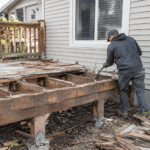
Wooden patio removal is generally faster and less equipment intensive than concrete but it comes with its own set of considerations. The main one in Vancouver is rot. Wooden patios that have been exposed to years of rain and moisture often have significant rot in the structural members, joists, and posts, even when the decking boards on top still look acceptable. A removal crew needs to handle rotting wood carefully because structurally compromised sections can fail unexpectedly during dismantling.
Wooden patios also tend to have more connection points to the house and to underground footings than concrete slabs. Detaching a wooden patio from a house without damaging the exterior cladding or the adjacent wall takes care and experience. And the concrete footings that supported the posts often need to come out too, which brings a small amount of concrete work into what otherwise looks like a straightforward timber removal job.
Pavers and tile patios sit between the two in terms of complexity. Individual pavers can sometimes be salvaged and reused if they’re in good condition, which is worth discussing with the our professional team before the job starts. Tile patios over a concrete base essentially combine both types of removal work.
What Patio Demolition in Vancouver Actually Looks Like on the Day
Here’s a realistic walk-through of what happens when a our expert patio removal team shows up at your Vancouver home.
Pre-job assessment and setup. We walk the patio with you before starting, confirms what’s being removed, checks the access route for getting debris out of the property, and sets up any necessary protection for adjacent surfaces like fencing, garden beds, or exterior walls. On a concrete job, this is also when the approach to breaking is decided, whether hand tools, mechanical breaking equipment, or a combination of both depending on the thickness and condition of the slab.
Disconnecting any attached elements. If the patio has lighting, an outdoor power outlet, irrigation running under it, or any attachment points to the house or a fence, these get addressed before demolition starts. Skipping this step leads to damage that costs more to fix than the removal itself.
The demolition work. For concrete, this means breaking the slab into manageable sections. This is noisy, dusty work and it takes time to do properly. Rushing the breaking process leads to oversized chunks that are harder and more dangerous to move. For wood, it means systematically dismantling from the top down, removing decking boards, then joists, then beams, then posts, then dealing with footings.
Loading and hauling. Broken concrete and demolition timber both need to be moved from the work area to the truck efficiently. On a larger patio job, this is where a significant portion of the total job time goes. Material gets staged, loaded, and cleared progressively rather than left in a pile for a single haul at the end.
Site cleanup. Once everything is loaded and gone, the area gets cleared of dust, debris, and any remaining material. What you’re left with is a clean, cleared outdoor space ready for whatever comes next, a new build, a landscaping project, or simply a level open area.
Final walkthrough. Before our crew leaves, they walk through the cleared area with you to confirm everything looks right and you’re satisfied with the result.
How Long Does Patio Removal Takes?
Realistic timeframes depend on the size of the patio, the material, and the complexity of the access situation.
A small to medium wooden patio of around 150 to 200 square feet with straightforward access can typically be demolished and cleared in three to five hours by a two person crew. A concrete patio of the same size takes longer because of the breaking work involved, usually five to seven hours depending on thickness.
Larger patios, those over 300 to 400 square feet, or those with complicating factors like thick reinforced concrete, difficult property access, or footings that need to come out, can extend to a full day or occasionally into a second day for the largest jobs.
What Happens to the Debris After Patio Removal
Provident Junk Removal is committed to eco-friendly disposal practices. Concrete from patio demolition doesn’t go to a general landfill when it’s handled responsibly. Broken concrete is a recyclable material that gets processed into aggregate and reused in construction applications like road base and fill material. This is significantly better than burying it in a landfill and it’s the standard for responsible debris disposal in Metro Vancouver.
Timber from wooden patio removal gets sorted based on condition. Wood that can be diverted from landfill goes through wood waste processing streams. Metal components including rebar, brackets, post anchors, and hardware get separated for metal recycling.
What to Think About Before Booking a Patio Removal Service in Vancouver
A few things are worth sorting out before you call to book your patio removal.
Know roughly what you have. Is it concrete or wood? How large is it approximately? Is there anything attached to it like a pergola, a roof structure, or built-in lighting? The more detail you can give when you call, the more accurate the estimate you’ll receive.
Check underground utilities. If your patio has footings that need to come out or if there’s any digging involved, it’s worth confirming that no underground utilities run beneath the area before work starts.
Think about what comes next. What are you planning to do with the space after the patio is removed? If a new contractor is coming in immediately after to pour a new slab or start a landscaping project, the patio removal needs to be timed accordingly. Let the team know about any follow-on work so the site is left in the right condition for whoever comes next.
Get a proper on-site estimate. A phone quote for a patio removal job is always going to be approximate. The thickness of the concrete, the condition of the wood, the access situation, and the specifics of what needs to come out all affect the scope and the cost in ways that aren’t visible without seeing the job in person. An on-site estimate protects you from surprise charges and gives the removal team a clear picture of what they’re walking into.
Your Old Patio Doesn’t Have to Be Your Problem Anymore
At this point you know what the job involves, what to expect on the day, how different materials change the scope of the work, and what questions to ask before you book. That puts you in a much better position than most Vancouver homeowners when they start looking for a patio removal service.
Provident Junk Removal handles patio demolition and removal across Vancouver and the entire Lower Mainland including Surrey, Burnaby, Coquitlam, Richmond, North Vancouver, West Vancouver, Langley, Abbotsford, and beyond. We do proper on-site assessments, give you a clear and honest quote before anything starts, bring the right equipment for the specific type of patio you have, and leave the site clean and ready for whatever you have planned next.
Moe and the team are ready to come take a look and give you a straight answer on what your job involves and what it will cost.
Call us at +1 (672) 667 4238 to schedule your free on-site estimate. The patio has been there long enough. Time to make way for something better.