Chemical Waste Disposal in Vancouver: What You Have, What It Is, and Where It Actually Needs to Go
A few months ago our team showed up to do a garage cleanout for a homeowner in Burnaby.
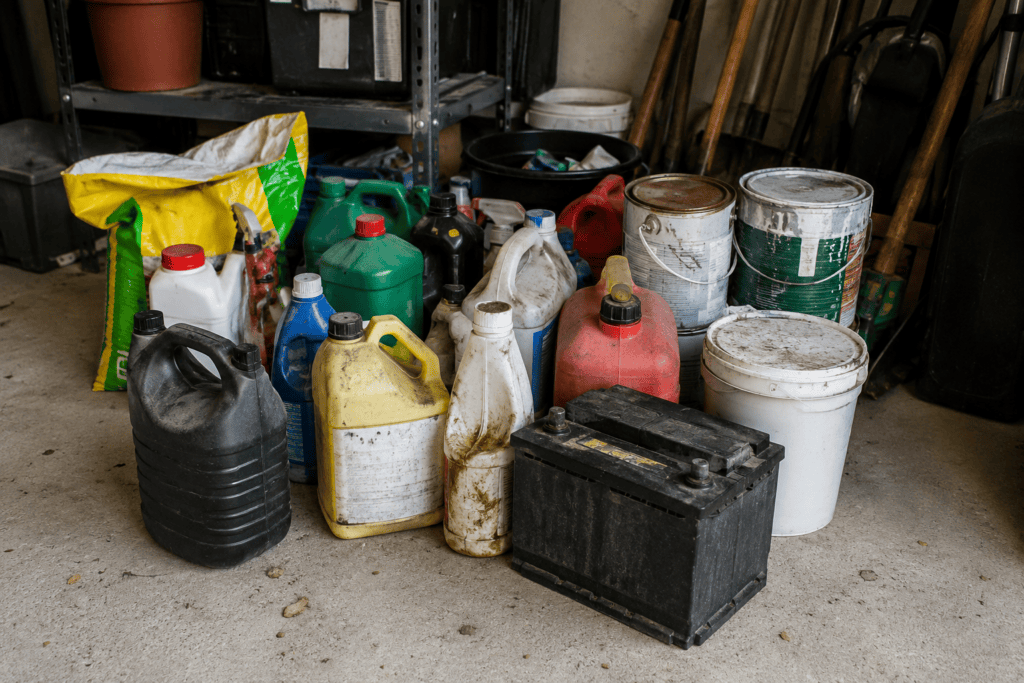
Standard job on the surface. Boxes, old furniture, sports equipment, the usual accumulation of years. But tucked along the back wall of the garage was a shelf that told a different story. Fourteen paint cans, a collection of garden chemicals with labels so faded you could barely read them, three containers of motor oil, a rusty can of what was probably solvent from a project in the early 2000s, and two car batteries sitting directly on the concrete floor.
The homeowner had no idea what any of it was classified as or where it was supposed to go. She just knew it had been there for years and she wanted it gone.
This situation is incredibly common during property cleanouts. Across the Lower Mainland, garages, basements, garden sheds, and utility rooms are full of old paint cans, pesticides, fertilizers, solvents, and other chemical products that were bought for a project, used once or twice, and then pushed onto a shelf where they sat for years.
Most people keep them because they aren’t sure how to dispose of them safely. Then, when it’s finally time to clean out the space, those leftover chemicals become the biggest challenge. Everything else can usually be sorted quickly, but the chemical shelf is where many people stop because they don’t know what can be thrown away and what needs special disposal.
Why Getting Rid of Chemical Waste Isn’t Always Easy
If you’ve ever cleaned out a garage, basement, or shed, you’ve probably found a few containers of old paint, pesticides, motor oil, or other chemicals and wondered, “Can I just throw these away?”
The answer depends on what you’re dealing with.
Not all chemical waste is handled the same way. Some items can be dropped off at recycling depots, while others need to go to facilities that accept hazardous household waste. For example, a can of leftover latex paint and a container of used motor oil might both be sitting on the same shelf, but they follow completely different disposal processes.
Throwing them away the wrong way can create bigger problems. Chemicals should never be poured down sinks, toilets, or storm drains because they can contaminate local waterways and put extra strain on Metro Vancouver’s wastewater system. Hazardous materials also don’t belong in your household garbage, and illegal dumping can result in significant fines. Even leaving old containers sitting around for years isn’t ideal, as they can leak, corrode, or become unsafe over time.
Fortunately, you don’t have to figure it all out on your own. Some household chemicals can be dropped off at designated recycling or hazardous waste facilities, while others are better handled by a professional junk removal company like Provident Junk Removal as we know where each type of waste needs to go.
The first step is simply knowing what you have. From leftover paint and pesticides to used motor oil and old batteries, here’s a look at the most common types of household chemical waste and which ones need to be treated as hazardous.
Category 1: Paint and Painting Products
Paint is by far the most common chemical waste found in Vancouver homes and it is also one of the most misunderstood from a disposal standpoint.
Latex paint (water-based) is the most common type used in residential homes today. Fully dried latex paint is generally not classified as hazardous waste. If a can of latex paint is completely dry and hardened, it can often go in the regular garbage with the lid off to show it is dry. If it is still liquid, it cannot go in regular garbage and needs proper disposal.
Oil-based paint is a different situation entirely. Oil-based paint contains solvents and is classified as hazardous waste regardless of whether it is liquid or dried. It cannot go in regular garbage, cannot be poured down a drain, and needs to go through specific waste management program.
Paint thinner, solvents, and strippers are classified as hazardous waste and need to go to a hazardous waste facility. These are genuinely not something to put in the bin and hope for the best.
Category 2: Garden and Lawn Chemicals
Vancouver homeowners use a significant range of garden chemicals, pesticides, herbicides, fungicides, fertilizers, slug bait, and weed killers, and the garage or garden shed is where most of them end up when the project is done and the remainder gets stored for next time.
The classification here varies significantly by product type.
Pesticides and herbicides are almost always classified as hazardous waste and need to go to Metro Vancouver’s hazardous waste programs. These are the products that most commonly end up in garages for years because people are not sure how to get rid of them.
Synthetic fertilizers in solid form that are still sealed and in good condition can sometimes be used up rather than disposed of. If they need to go, they should not be poured down drains or scattered randomly as excess fertilizer runoff contributes to water quality problems in Metro Vancouver’s waterways.
Slug bait and rodent bait containing active pesticide compounds need to go through hazardous waste disposal rather than general garbage because the active compounds are toxic and can affect wildlife if they end up in landfill.
Old garden chemicals with illegible labels deserve specific mention. If you find a container of garden chemicals and you cannot read the label clearly enough to identify what it is, treat it as hazardous waste. Do not open it to smell it, do not mix it with anything, and do not try to use it.
Category 3: Automotive Fluids
Motor oil, antifreeze, brake fluid, transmission fluid, and windshield washer concentrate are extremely common in Vancouver garages and each one has its own disposal pathway.
Used motor oil is one of the most valuable chemical waste categories from a recycling standpoint. Used motor oil is not garbage. It is a recyclable resource that gets re refined into new lubricating oil or used as fuel in industrial applications.
Antifreeze contains ethylene glycol which is toxic to animals and cannot go into drains or regular garbage.
Brake fluid and transmission fluid are genuine hazardous waste categories that require proper handling.
Gasoline and mixed fuel from old generators, lawn equipment, or storage containers that has gone stale is one of the more challenging automotive fluid categories. Old gasoline cannot be poured down a drain, put in regular garbage, or left outside to evaporate (this is both dangerous and environmentally harmful). It needs to go to a proper facility in an approved container that is clearly labeled.
Category 4: Cleaning Products and Household Chemicals
Cleaning products are often overlooked in chemical waste conversations because people associate them with everyday household items rather than chemical waste. But certain categories of cleaning products require careful disposal.
Drain cleaners and oven cleaners containing strong alkalis or acids are genuinely corrosive and classified as hazardous household waste.
Bleach in household concentrations is generally acceptable to pour down the drain in small quantities with plenty of water because wastewater treatment systems handle it. However concentrated or industrial strength bleach can not be disposed of like that.
Aerosol cans that are completely empty can often go in regular recycling in Metro Vancouver depending on your municipality. Aerosol cans that are not fully empty cannot go in recycling and need to go to a waste facility because the remaining pressurized contents pose a safety risk in waste processing.
Pool and spa chemicals including chlorine compounds, pH adjusters, and algaecides need to go to a hazardous waste management facility. Pool chemicals are highly reactive and should never be mixed with other chemicals, placed in sealed containers, or stored near heat sources while awaiting disposal.
Category 5: Batteries
Batteries are one of the most commonly mishandled items in household chemical waste and also one of the easiest to deal with properly.
Household alkaline batteries (the standard AA, AAA, C, D, and 9V batteries) are no longer classified as hazardous waste in BC and can technically go in regular garbage in Metro Vancouver, though recycling is always the better choice.
Rechargeable batteries including lithium ion, nickel cadmium, and nickel metal hydride types are hazardous and must be recycled.
Car batteries are hazardous waste and are also one of the most efficiently recyclable items. Lead acid car batteries have very high recycling value.
Lithium battery packs from power tools, e-bikes, laptops, and other devices need to go through recycling facilities. These batteries can be a fire hazard if damaged and should never be placed in regular recycling bins.
Category 6: Fluorescent Bulbs, Tubes, and Electronics
Fluorescent lights contain mercury and are classified as hazardous waste regardless of how old they are or whether they are still functional.
Old electronics beyond just bulbs, including televisions, computers, printers, and anything with a circuit board, need to go through e-waste recycling rather than regular disposal.
What Provident Junk Removal Does When Chemical Waste Is Part of a Property Cleanout
This is where we can be genuinely useful in a chemical waste situation, as Provident Junk Removal is licensed and equipped to safely remove hazardous waste including chemicals, solvents, batteries, and electronic waste. Proper disposal is our priority to protect you and the environment.
When our team arrives at a garage cleanout, estate cleanout, or property cleanout and encounters chemical waste, we do not just load it onto the truck along with everything else. We identify what appears to be chemical waste, set it aside separately, and then dispose it off through proper channels.
If you are booking a property cleanout and you know or suspect chemical waste is involved, the best thing you can do is mention it when you book so the crew is prepared to handle the situation properly rather than discovering it on the day.
Wrapping Up
Whether you have a few old paint cans, a collection of garden chemicals you cannot identify, or a full garage shelf of automotive fluids from years of car projects, we are here to help.
At Provident Junk Removal, we help Vancouver homeowners navigate exactly this kind of mixed cleanout situation. We handle chemical waste disposal responsibly and we take all sorts of hazardous waste. Our team identifies and separates chemical waste for the right disposal channels before anything gets loaded onto the truck.
We serve Vancouver, Surrey, Burnaby, Coquitlam, Richmond, North Vancouver, West Vancouver, Langley, Abbotsford, and all surrounding areas across Metro Vancouver.
Call us at +1 (672) 667 4238 to book your chemical waste disposal.